

Dear Essrea, God bless you,
Thank you for your love for my Living Stones.
I am sorry that I did not answer your email or fill the proposals needed. I had a very bad week that made me very busy and scared.
The story of what happened makes me scared for the future of the Church and the Christian community in Zababdeh and Jenin. It makes me think of the young people who want to leave to find safety, security, and a future. And they have the right to be scared.
First: Israel makes the West Bank like a prison, confiscating land and building more and more settlements. Thousands of workers have lost their jobs. Young people, after graduating from the universities, have lost hope
of finding work. Our activity as a Church becomes less and less. Another kind of Islam has appeared that we have not known before.
Second: the Palestinian Authority is part of the problem, not part of the solution. There is no support of any kind for their people, for many reasons. The Palestinians have lost trust in them. Personally, I have many concerns about the Governor of Palestine. I find they think in a way that does not help to build any kind of Palestinian state, but only to build a Palestinian Authority that takes us nowhere but into hell.
I studied their program 25 years ago, and I knew it would not take us anywhere. But we do not have freedom of expression, so I decided to keep silent and work for my ministry and help my people as a Palestinian.
The lesson of this story proves my belief and why I was not involved in any Palestinian Authority programs, activities, or work. On the contrary, every time they tried to push me to adopt their side against others, I answered, “I do not care.” They try to look good to the West by showing that we love their governor.
In other places like Syria and Iraq, the Christian communities paid a heavy price because they showed support to the Iraqi or Syrian authorities or governments. So I try not to copy the same experience.
I love Palestine and want my country to be free and to live in good relations with Israel and the surrounding Arab countries. This has been my faith all my life.
Four days ago, I was in the Church, angry because the mobile company closed my connection since I had no time to go to Jenin to pay the bill. Some people came to me because they trust me and believe I can help stop a crime against one of the families. I was very tired and upset about my mobile. I had promised my wife and children to have dinner with them, and we had planned to visit a family together.
I drove my car to the family’s home. I stopped a few meters away to be safe from stones or any kind of violence and walked to the house.
I thank God that the attackers had already left. I entered the house, greeted them, and we talked to find a solution. I understood their fear and what they were feeling, but I pushed them to think about reconciliation. I encouraged them to trust God and believe in our Lord’s message to reconcile and not seek revenge. They trusted me and my words and asked me to find a way.
My plan was to visit my friend, the Muslim imam, and take him to visit the other family, since they are Muslims.
While we were visiting peacefully, a boy ran to me and said, “Abouna, they crashed your car.”
I ran outside and found that they had broken the windows of my car. I thanked God in my heart. The boy told me which three young Muslim men had done it.
I prayed to forgive them because they do not know what they are doing. We do not know who pushed them to break my car windows to create a problem between me as a priest and the Muslim community in Zababdeh. If the broken windows push us into problems, I will pay the price myself. I said in my heart, “Lord Jesus, have mercy on us.”
I felt no hate and no desire for revenge. On the contrary, I felt peace inside.
I drove to the police department to make a report for the insurance company. I wanted to go home. Then I received a phone call that three young men had attacked my son, Butros, and wounded him.
I drove very fast and found Butros with a head wound. I took him to the hospital. He had ten stitches in his head.
We went back to the police to make another report. The next day, we were asked to go to Jenin with Butros to the police department. Butros and another boy were arrested because the three boys who attacked Butros claimed he attacked them.
Everyone was sent to court.
I followed to the court and waited for hours. To make it short, we faced a nervous judge. I wondered if it was because of my priest’s clothes — maybe this was his first time seeing a priest. He showed no respect and used cruel words. He did not trust my words.
I asked him to let Butros go because he was wounded and had a medical report. He did not listen. He listened to Butros and Majed only for a few minutes. Then he asked me to leave the court. He sentenced them to three months in prison.
I was shocked and nervous. I decided I would not leave the court and would stay there all night — no power in the world could force me to leave.
But I found a way to submit an appeal in the last ten minutes before the judge left. I literally ran to another building to write a reconsideration letter with money to pay for their release. I ran back, forgetting my headache and pain, and arrived just one minute before the judge left. He signed it at the last moment.
The agreement needed ten signatures from different departments before they would release Butros and Majed. I drove to many offices. It took two more hours. Then I returned to the main police department where they were imprisoned.
After another hour of waiting, they were released, and we went home safely.
From 9 in the morning until 6 in the evening, I was running everywhere.
I prayed inside myself: “Thank you, Jesus, for everything. Thank you for giving me the strength.”
But the problem is not finished. We must return to court again. We must find a solution to the whole issue. I believe they must pay a price for what they did to me and to Butros and Majed. It is not revenge — it is to do what is right and to stand for our rights.
In Zababdeh, I do not know if this would happen in other places, but as a Christian minority, we are used to giving up our rights when problems happen between Christians and Muslims. We were educated since childhood to live in fear because we are a minority and they are stronger. We were taught to avoid problems.
When I came back from the seminary to this area, I realized how strange this education was. That is one of the reasons I insist on supporting education in Zababdeh.
The story is not finished. Tonight, a group of elders visited me to talk and find a solution. I had no strength to speak. I thanked them, but I need more time to think about what kind of reconciliation is needed.
Every eye in Zababdeh looks to me. They find hope in what I am doing. They need courage and strength to forget the fear they were taught. They want to be free from fear.
I need time to pray in the Church and ask God for strength and peace — and to give this Christian community hope for a future in this part of the world.
Keep me in your prayers. Your prayers give power to my ministry and to our community.
We need your prayers to strengthen the Church. If we do not stand firm, I believe they will leave. If they feel they have no leaders who care for them, I fear there will be no future for Christians in Palestine.
Thank you.
Your brother,
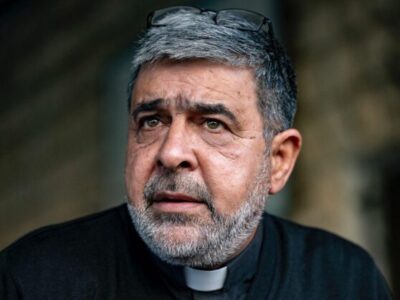
Abouna Firas
Firas Khoury Diab, Parish Priest
Zababdeh, Palestine